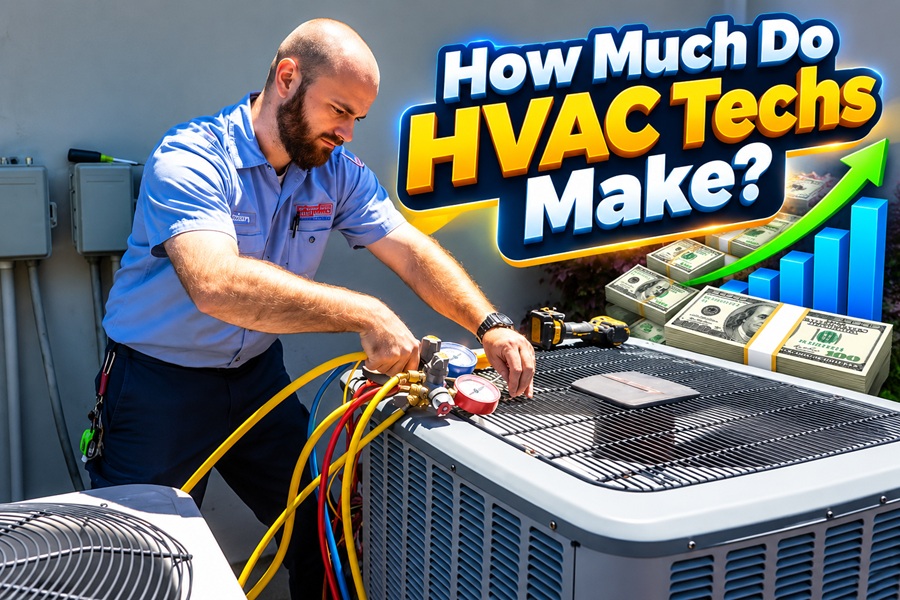
Heating and cooling equipment keeps homes, offices, hospitals, factories, and other buildings comfortable throughout the year. When a system stops working, HVAC technicians use their technical knowledge to diagnose problems, install equipment, and restore reliable operation. If you’re considering this skilled trade, one of the first questions is naturally how much do HVAC techs make?
In the United States, earnings depend on experience, location, employer, specialization, certifications, and working hours. The U.S. Bureau of Labor Statistics reported a median annual wage of $59,810 for heating, air conditioning, and refrigeration mechanics and installers in May 2024. This is a national median, not a guaranteed starting salary or a figure that applies to every HVAC position. Apprentices often earn less while training, while experienced technicians with specialized skills, overtime, or leadership responsibilities may earn more. Understanding the factors behind pay can help you decide whether this career fits your financial and professional goals.
HVAC Technician Salary at a Glance
| Salary factor | What to know |
|---|---|
| U.S. median annual wage | $59,810 in May 2024 |
| Typical pay structures | Hourly wages, annual salaries, overtime, or commission arrangements |
| Entry-level pay | Often lower than experienced technician earnings |
| Higher earning opportunities | Commercial work, refrigeration, controls, leadership, and business ownership |
| Main influences | Location, experience, employer, and qualifications |
| Common workplaces | Homes, offices, factories, retail buildings, and industrial facilities |
| Important consideration | Current local wages may differ from historical national figures |
What Does an HVAC Technician Do?
HVAC stands for heating, ventilation, and air conditioning. Technicians install, maintain, inspect, diagnose, and repair equipment that controls indoor temperature and airflow. Some also work with refrigeration systems and building automation controls.
A residential technician might investigate an air conditioner that is not cooling, replace a failed component, inspect airflow, and explain maintenance requirements to a homeowner. A commercial technician may work on larger rooftop units, ventilation systems, control equipment, or refrigeration installations.
The job combines practical work with technical problem-solving. Technicians use tools, testing equipment, diagnostic instruments, and technical documentation. They must understand electrical and mechanical systems, follow safety procedures, and communicate clearly with customers and facility managers.
HVAC work includes more than emergency repairs. Preventive maintenance, system installation, equipment replacement, and energy-efficiency improvements are also common. This variety creates opportunities for people who enjoy hands-on work and continuous learning.
How Much Do HVAC Techs Make Per Hour?
Hourly pay depends on the region, job type, experience, and employment arrangement. A worker earning $59,810 annually would have an approximate equivalent of $28.75 per hour if the pay were spread across 2,080 hours, representing 40 hours per week for 52 weeks.
This calculation is a comparison tool, not a guarantee of the hourly rate for a particular job. Actual annual earnings may differ because of overtime, seasonal work, unpaid time between jobs, commissions, or different schedules.
| Annual earnings | Approximate hourly equivalent |
|---|---|
| $35,000 | $16.83 |
| $45,000 | $21.63 |
| $55,000 | $26.44 |
| $59,810 | $28.75 |
| $70,000 | $33.65 |
| $85,000 | $40.87 |
These figures are mathematical conversions, not verified salary bands for particular experience levels. They represent gross pay before taxes, insurance deductions, and other expenses.
Why Hourly Pay Does Not Tell the Whole Story
Two technicians with the same hourly rate can receive different total compensation. One may have steady work throughout the year, while another experiences seasonal fluctuations. Overtime can increase earnings but requires more time at work.
Benefits matter as well. Health insurance, retirement contributions, paid leave, training, and a company vehicle can add significant value. When comparing positions, consider the complete compensation package rather than focusing only on the advertised hourly rate.
HVAC Technician Salary by Experience
Experience influences pay because complex troubleshooting and independent decision-making develop through practical work. A beginner may understand basic concepts but need guidance when diagnosing unusual equipment faults.
The following figures are illustrative career-planning ranges rather than official wage bands. Actual salaries depend on local labor markets and employers.
| Career stage | Illustrative annual earnings |
|---|---|
| Apprentice or beginner | $30,000 to $42,000 |
| Early-career technician | $38,000 to $52,000 |
| Experienced technician | $50,000 to $70,000 |
| Senior or specialized technician | $65,000 to $85,000 or more |
| Supervisor or service manager | $70,000 to $100,000 or more in some markets |
The ranges overlap because job titles are not standardized. A skilled worker in a high-wage city may earn more than a technician with greater experience in a lower-wage region.
Entry-Level Technicians
Entry-level technicians often assist experienced workers, prepare equipment, complete basic maintenance tasks, and learn safe installation procedures. Their responsibilities may be limited until they gain enough experience to work independently.
Apprenticeships provide structured training alongside employment. Pay may begin below that of a fully qualified technician, but apprentices gain practical experience while learning the trade.
Beginners can strengthen their prospects by learning electrical fundamentals, refrigeration principles, airflow measurement, tool use, and systematic troubleshooting. Reliability, punctuality, and good communication are also valuable.
Experienced Technicians
Experienced technicians may earn more because they can diagnose faults accurately, complete repairs efficiently, and work on a wider range of equipment.
Knowledge of commercial HVAC, heat pumps, refrigeration, or advanced controls can improve career options. However, experience alone does not guarantee a higher salary. Location, employer pay policies, certifications, and the type of work available still matter.
Senior Technicians and Supervisors
Senior technicians may handle difficult service calls, train junior employees, review work, or coordinate jobs. Supervisors and service managers often take on scheduling, customer escalations, inventory management, and team performance.
These positions can pay more, but they may involve additional administrative responsibility. Some technicians prefer advanced technical work, while others enjoy leading teams.
Which HVAC Specialties Can Pay More?
Commercial HVAC
Commercial technicians work on equipment used in offices, schools, retail buildings, warehouses, hospitals, and other facilities. These systems may involve larger equipment, sophisticated controls, and more complex maintenance requirements.
Commercial experience can improve career options, although compensation varies by region, employer, and qualifications. Some positions also involve evening or overnight work to avoid disrupting building operations.
Refrigeration
Refrigeration technicians work with systems used in supermarkets, restaurants, food storage facilities, and industrial environments. Depending on the job, they may service compressors, controls, cooling equipment, and temperature-monitoring systems.
Some refrigeration roles require rapid response because equipment failures can affect stored products or business operations. Specialized training and appropriate refrigerant-handling credentials can support career progression.
HVAC Controls and Building Automation
Modern buildings use electronic controls to coordinate heating, cooling, ventilation, and energy management. Technicians who understand sensors, control wiring, communication protocols, and automation systems may qualify for specialized roles.
This work can involve more diagnostic analysis and programming than routine component replacement. Employers may expect experience with particular control platforms or commercial building systems.
Heat Pumps and Energy-Efficient Equipment
Heat pumps and other efficient systems require knowledge of installation requirements, controls, equipment sizing, and troubleshooting. Continuing education can help technicians adapt as products and service procedures change.
Specialization may improve opportunities, but earnings depend on actual local demand, employer requirements, and technical competence.
How Location Affects HVAC Technician Pay
Location is an important salary factor. Labor costs, housing expenses, construction activity, climate, and competition for skilled workers can all influence wages.
Regions with very hot summers or cold winters may experience strong seasonal demand for particular services. Large metropolitan areas may offer more specialized positions but also have higher living expenses. Smaller markets may offer fewer employers but different opportunities for independent work.
A high advertised salary does not automatically produce a better financial outcome. Compare wages with housing, transport, taxes, insurance, and training expenses.
When researching jobs, review current local wage data and actual job postings. Check required experience, benefits, overtime policies, travel expectations, and whether the employer provides tools or a vehicle.
Education, Apprenticeships, and Certifications
HVAC technicians enter the trade through several routes. Some complete vocational programs, while others enter apprenticeships or receive employer-provided training. The right route depends on local requirements, available programs, and career goals.
Training can cover refrigeration, electrical circuits, airflow, heating equipment, controls, safety, and diagnostics. Practical experience is essential because real equipment does not always behave exactly as expected in a classroom.
In the United States, technicians handling regulated refrigerants may need the appropriate EPA Section 608 certification. State and local licensing requirements vary, so check the rules where you intend to work.
Certifications can strengthen a résumé, but employers also value reliability, problem-solving, safe work practices, customer service, and the ability to learn new equipment.
How HVAC Technicians Can Increase Their Earnings
Developing specialized skills can help technicians qualify for more responsible roles. Commercial controls, refrigeration, heat pumps, and advanced diagnostics are potential areas for further training.
Strong troubleshooting skills are valuable because accurate diagnosis can reduce repeat visits and unnecessary part replacements. Technicians who explain problems clearly can build customer confidence and support better service decisions.
Overtime can increase earnings during busy periods, but the extra pay should be weighed against fatigue, travel, and personal responsibilities. A position with slightly lower base pay may offer better benefits or more reliable working hours.
Experienced technicians may also move into management, training, project coordination, or independent contracting. Business ownership can offer opportunities, but revenue is not the same as personal income. Insurance, tools, vehicles, administration, marketing, and taxes all affect profitability.
Is HVAC a Good Long-Term Career?
HVAC can provide a route into a skilled trade without necessarily requiring a traditional four-year college degree. Apprenticeships and technical programs can help people build skills while preparing for employment.
The work is varied, and experienced technicians can explore residential service, commercial equipment, refrigeration, controls, supervision, or business ownership. Demand varies with construction activity, economic conditions, equipment replacement, and regional climate.
There are trade-offs. Technicians may work in hot attics, cold outdoor conditions, confined spaces, and physically demanding environments. Emergency calls, travel, and seasonal peaks can also affect work-life balance.
Before committing, speak with local employers, investigate training costs, and learn what a typical working week looks like in your chosen specialty.
Conclusion
So, how much do HVAC techs make? The U.S. Bureau of Labor Statistics reported a median annual wage of $59,810 for heating, air conditioning, and refrigeration mechanics and installers in May 2024. Actual earnings vary by experience, location, specialization, employer, and working hours.
Beginners generally earn less while developing practical skills. Experienced technicians may improve their prospects through commercial work, refrigeration, controls, leadership, and additional training. These opportunities can support career growth, but no certification or specialty guarantees a particular salary.
Research current local wages, compare benefits, and understand the physical demands before choosing a training route. With practical experience and a commitment to learning, HVAC can offer a flexible career path within the skilled trades.
Frequently Asked Questions
1. What is the median salary of an HVAC technician?
The U.S. Bureau of Labor Statistics reported a median annual wage of $59,810 for heating, air conditioning, and refrigeration mechanics and installers in May 2024. Individual salaries vary by region, experience, and job type.
2. Can HVAC technicians earn $100,000 a year?
Some may reach or exceed that amount through specialized work, overtime, management, commission arrangements, or business ownership. It is not a guaranteed or typical salary for every technician.
3. Do commercial HVAC technicians earn more?
Commercial roles may pay more in some markets because of equipment complexity and specialized requirements. The difference depends on location, employer, and qualifications.
4. How long does it take to become an HVAC technician?
The timeline depends on training, apprenticeship requirements, and the level of responsibility you want to reach. Practical experience and relevant credentials support progression.
5. Is HVAC a good career without a four-year degree?
HVAC can be a viable skilled-trade career through technical education, apprenticeships, and employer training. Requirements vary by location, and success depends on practical ability, safety, reliability, and continued learning.